
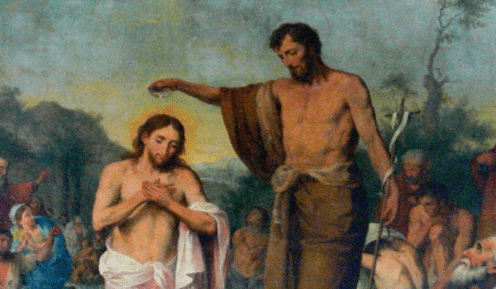
When Jesus was born, His mother embraced Him. When Jesus was baptized, His Father consecrated Him. Jesus Christ was baptized, not to be made holy by the water, but to make the water holy, to purify the waters which touched His body. The Baptism of the Lord was one of His first saving actions: For when the Savior was baptized, the waters of Christian baptism was sanctified for the dispensing of grace to all Christians. Christ the Head had to be baptized, so that members of His mystical Body can benefit from baptismal grace.
A little-known aspect of the mystery of baptism is that when Jesus presented Himself to John the Baptist for baptism, He was already anticipating His death. His immersion under the waters of the Jordan prefigured His death. Christian baptism is more than a cleansing; it is a participation in the death of Christ, His descent into hell and His resurrection. In the letter to the Colossians, St. Paul describes it with these words: “You were buried with Him in baptism, in which you were also raised with Him through faith in the power of God, who raised Him from the dead” (Colossians 2:12). Without death, there can’t be new life. Christian baptism is more than just a rite of passage – it is a rebirth, a new beginning!
The Apostles Creed profess that Jesus descended into hell. This happened after He died on the Cross and was buried, and before He rose from the dead after three days. The “hell” that Jesus descended into is what scripture calls the abode of the dead – Sheol in Hebrew because those who are there were deprived of the vision of God. Such was the case for all the dead, whether evil or righteous, as they awaited the Redeemer. However, it was the righteous, who awaited their Savior, whom Christ delivered when He descended into hell. Jesus did not descend into hell to deliver the damned, nor to destroy the hell of damnation, but to free the souls of the righteous (CCC 633).
By the expression “He descended into hell,” the Apostles Creed confesses that Jesus really died and through His death conquered death (CCC 636). The human soul of Christ, united to His divine person, entered the realm of the dead. He opened heaven’s gates for the just who had gone before Him (CCC 637).
Baptism is a one-time event. The Church tells us that the sacrament of baptism can only be received once in a lifetime. Although it is true to say that once baptized, always baptized; some Christians misunderstand baptism in terms of once saved, always saved. Baptism reveals the great drama of Christian existence: the Christian life is about continually dying to sin and being alive to God in Christ. In this way, the Christian life is a continuing participation in the death of Christ.
St. Paul relates his own suffering in the ministry to the death of Christ by saying: “We always carrying about in the body the death of Jesus, so that His life may also be manifested in our body. For we who live are constantly being given up to death for the sake of Jesus, so that the life of Jesus may be manifested in our mortal flesh. So, death is at work in us, but life in you.” (2Cor 4:10-12). St. Paul’s personal sacrifices each and every day is his ongoing death in Christ for the good of the Church and its members.
The two sacraments of Baptism and the Eucharist jointly shows the connection between death and life in Christ. The death to sin in baptism is fulfilled in a life in Christ in the Eucharist. In baptism, Christ calls us to share in His death, but in the Eucharist, He calls us to share in His life of communion with the Father. Through grace, we are called to a transformation in life so that we may truly be dead to sin and alive to God.